Cats with Glasses Procreate Brush Guide
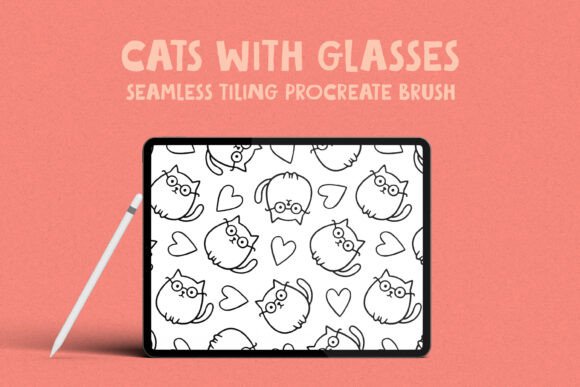
Creating cohesive surface patterns often requires hours of tedious alignment, masking, and offset testing to ensure tiles match perfectly. The Cats with Glasses Procreate Brush eliminates this technical friction by embedding the repeat logic directly into the stroke engine. Instead of building a pattern swatch from scratch, you simply paint, and the brush generates a continuous, seamless field of bespectacled felines and small hearts in real time. This tool transforms pattern creation from a complex technical workflow into an intuitive drawing experience, allowing designers and hobbyists to focus on composition rather than grid mathematics.
The visual character of this brush is distinctively high-contrast and graphic. Unlike raster brushes that rely on opacity or textured shading, this asset produces clean, bold black line art with absolutely no gray tones. This binary aesthetic is intentional. It ensures maximum versatility across both digital and print mediums. The absence of anti-aliasing artifacts or soft shadows means the artwork remains crisp at any scale, making it functionally similar to a vector-based display font or a premium icon set. The personality is playful yet structured; the glasses add a touch of intellectual whimsy to the cats, while the consistent line weight maintains professional uniformity suitable for commercial brand identity projects.
Strategic Applications Across Print and Digital Media
While often categorized as a novelty asset, this brush serves specific functional roles in professional design workflows. Its utility extends far beyond simple decoration, acting as a foundational element for various product categories. Understanding where this specific visual style performs best helps creators maximize their return on investment when integrating it into larger projects.
Coloring Books and Activity Pages
The most immediate application for this brush is in the publishing sector, specifically for adult coloring books and children’s activity pages. The strict black-and-white output is not merely a stylistic choice but a production necessity. Coloring pages require pure line work without pre-existing shading that might interfere with a user's medium of choice. Because the Cats with Glasses Procreate Brush outputs solid black lines on a transparent or white background, it bypasses the need for threshold adjustments or cleanup. Publishers can generate dozens of unique page layouts in minutes, filling negative space with consistent density. The whimsical subject matter appeals to the "cozy mystery" or "cute animal" niches currently dominating Amazon KDP and Etsy printable markets.
Print-on-Demand and Merchandise Design
For entrepreneurs managing print-on-demand storefronts, speed and consistency are critical metrics. This brush allows for rapid prototyping of all-over print designs for apparel, mugs, notebooks, and tote bags. The seamless tiling capability ensures that no matter how the design is cropped or scaled on a product mockup, the pattern remains unbroken. This is particularly valuable for creating coordinated collections. A designer can use the same brush to create a matching set of social media graphics, packaging inserts, and product backgrounds, ensuring visual cohesion across the entire brand identity. The bold line weight also translates exceptionally well to screen printing and direct-to-garment technologies, where fine details often get lost or require expensive halftone separation.
Digital Stationery and Scrapbooking
In the digital planning community, high-contrast assets are prized for their readability on tablet screens. When used as digital paper or sticker backgrounds, the clean lines prevent visual noise that can make text difficult to read. This makes the brush ideal for creating functional yet decorative elements in GoodNotes or Notability planners. The pattern acts as a texture that adds warmth without competing with handwritten notes or typed content, balancing aesthetic appeal with practical usability.
Evaluating Fit and Technical Integration
Integrating any specialized design asset requires evaluating its compatibility with your existing workflow and project goals. While this brush solves specific problems, it is not a universal solution. Treating it with the same scrutiny you would apply to selecting a commercial font or typeface ensures better long-term results.
Assessing Visual Hierarchy and Pairing
Because the pattern features recognizable characters with strong silhouettes, it carries significant visual weight. When incorporating this brush into layouts containing typography, consider the hierarchy carefully. The intricate nature of the cat illustrations pairs best with simple, geometric sans serif fonts or clean modern typography. Avoid pairing it with highly ornate script fonts or detailed serif fonts, as the competing complexities can reduce legibility and create visual clutter. If using the pattern as a background for text, ensure there is sufficient contrast; placing dark text directly over the black line art will fail accessibility standards. Utilize solid color blocks or reduced opacity layers behind text areas to maintain readability while retaining the pattern's charm in the periphery.
Understanding Source Material and Licensing
Transparency regarding asset origin is increasingly important for professional integrity and legal safety. The original artwork for this pattern was created with AI assistance and then meticulously edited and refined in Photoshop to produce a clean, seamless result. This hybrid workflow is significant for users concerned about the raw quality of generative AI. The manual refinement process corrects common AI artifacts like anatomical errors, inconsistent line weights, and non-repeating edges. However, when using this for commercial products, always verify the specific licensing terms included with your purchase. Just as you would check the EULA for a premium font, confirm whether the license covers unlimited commercial reproduction, modification rights, and usage in trademarked logos. The refined nature of this asset generally places it in a safer category than raw AI generation, but due diligence remains essential for business owners.
Testing for Production Readiness
Before committing to a large print run or finalizing a digital product, conduct physical tests. Screen resolution differs vastly from print output. What looks bold on an iPad may appear too thick or too thin on cardstock. Print test swatches at actual size to evaluate line weight relative to the substrate. For coloring books, test with markers, colored pencils, and gel pens to ensure the paper stock and line thickness interact correctly. For apparel, request a sample print to verify that the black ink saturation meets expectations. This validation step mirrors the proofing process used in editorial design and packaging design, preventing costly reprints and ensuring the final product matches the digital preview.
Optimizing Workflow Efficiency
The primary value proposition of the Cats with Glasses Procreate Brush is time compression. In traditional surface pattern design, creating a seamless repeat involves defining a bounding box, duplicating elements, and manually fixing edge intersections. This brush automates that cognitive load. To maximize efficiency, organize your Procreate canvas with dedicated layers for the pattern fill and separate layers for foreground elements. This non-destructive approach allows you to adjust the pattern layer independently—changing blend modes, applying color overlays, or erasing sections to create framing effects—without altering the base tile logic.
Furthermore, consider this brush as a modular component within a larger toolkit. While it excels at full-background fills, it is equally effective for creating borders, dividers, and spot illustrations. By using the brush with short, controlled strokes rather than broad sweeps, you can extract individual motifs or create custom arrangements that break the grid. This flexibility allows the asset to transcend simple background status and become a versatile element in logo design exploration, web design accents, and social media graphics. The key is to view the brush not just as a pattern generator, but as a library of pre-aligned, stylistically consistent graphical components ready for deployment across diverse creative challenges.