Retro Cartoon Faces PNG Brushes: Adding Vintage Charm to Modern Design Workflows
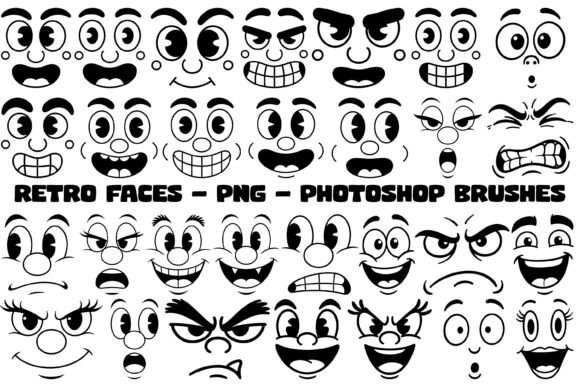
There is a distinct warmth to mid-century illustration that digital design often struggles to replicate. The Retro Cartoon Faces PNG Brushes collection bridges this gap by offering high-resolution, transparent assets that capture the expressive, hand-drawn aesthetic of vintage animation while maintaining the crisp utility required for modern production. Unlike standard vector packs that can sometimes feel sterile or overly geometric, these assets retain the organic imperfections and bold linework characteristic of classic rubber-hose animation and golden-age comic strips. For designers, illustrators, and print-on-demand sellers, this set functions less like a static clip-art library and more like a dynamic toolkit for injecting personality into layouts, merchandise, and digital content.
Beyond Nostalgia: Practical Applications in Merchandise and POD
The most immediate value of this collection lies in the Print-on-Demand (POD) and sublimation markets. Retro aesthetics are currently dominating trends on platforms like Etsy, Redbubble, and Amazon Merch, but creating original character art for every single listing is time-prohibitive. These brushes solve the volume problem without sacrificing quality. Because the faces are provided as 5000-pixel transparent PNGs at 300 DPI, they are production-ready for large-format printing. A designer creating a line of vintage-style tote bags can stamp a "mischievous" face onto a canvas texture in seconds, adjust the opacity to simulate aged ink, and have a sellable mockup ready in minutes.
For sublimation specifically, the high-contrast black linework is a significant advantage. Sublimation printing on polyester blends often struggles with subtle gradients or low-contrast details getting lost in the transfer process. The bold, edited lines in this set ensure that expressions remain readable and punchy even after heat pressing. Whether you are designing tumblers, phone cases, or apparel, the artwork maintains its integrity. The inclusion of six seamless repeating patterns further extends this utility; these 3600 x 3600 pixel JPGs allow for all-over print designs on fabric or wrapping paper without visible tiling seams, turning a single asset pack into a comprehensive surface pattern library.
Streamlining Editorial and Brand Illustration
Graphic designers working in editorial, publishing, or branding often need spot illustrations to break up text or add visual interest to headers. Sourcing consistent retro imagery from stock sites can result in a disjointed look where three different images appear to be from three different decades. Using the Photoshop brush set (.ABR) included in this package ensures stylistic consistency across an entire project. A magazine layout about nostalgia, mental health, or pop culture can utilize the "grumpy," "surprised," and "happy" variants as recurring motifs throughout the spread, creating a cohesive visual language that feels custom-commissioned rather than assembled.
The brush format also offers non-destructive flexibility that static PNGs cannot. When working in Photoshop, you can resize, rotate, and recolor these faces instantly without losing edge definition. This is particularly useful for web banners or social media templates where dimensions change frequently. Instead of dragging and dropping individual files, a designer can paint directly onto a layer mask or use blending modes like Multiply to integrate the cartoon faces seamlessly with textured backgrounds, photographs, or colored paper effects. This workflow mimics traditional collage techniques while retaining full digital editability.
The Coloring Book and Activity Sheet Market
A unique aspect of this collection is its origin and post-processing. While AI-generated, each image has been manually edited in Photoshop to refine the linework. This distinction matters immensely for the coloring book niche. Raw AI output often contains gray artifacts, broken lines, or nonsensical anatomy that frustrates colorists. The cleaned-up, high-contrast nature of these retro cartoon faces makes them ideal for creating activity books for both children and adults. The expressions are distinct enough to convey emotion without being overly complex, providing satisfying regions for colored pencils or markers.
Creators in this space can combine multiple faces to create narrative scenes or use the seamless patterns as decorative borders and backing pages. Because the assets are transparent, they can be layered over other line art elements—vintage cars, diners, household objects—to build rich, thematic coloring pages rapidly. For educators or therapists using art-based activities, the variety of emotional expressions (happy, grumpy, surprised) also serves as a practical tool for emotional literacy exercises, allowing users to identify and discuss feelings through accessible, non-threatening retro characters.
Technical Considerations for Professional Integration
While the versatility of Retro Cartoon Faces PNG Brushes is a major strength, understanding the technical specifications ensures the best results. The 5000-pixel dimension on the longest side provides ample headroom for cropping and scaling, but users should always work at 300 DPI for physical products to avoid pixelation. For digital-only projects, such as web graphics or video overlays, consider batching the export to smaller sizes to optimize load times, as the master files are intentionally heavy for print fidelity.
When using the .ABR brush file, be mindful of brush spacing and hardness settings. Since these are raster-based brushes rather than vector shapes, zooming in beyond 100% will reveal pixel edges. This is actually desirable for achieving an authentic retro print look, as it mimics the halftone or lithographic texture of old comics. However, if your project requires infinite scalability for billboards or vehicle wraps, you may need to use the high-res PNGs as a base for manual vector tracing or image trace workflows. The provided resolution is excellent for most commercial applications, but knowing when to switch from brush-stamping to placed smart objects is key to maintaining professional quality across varying output sizes.
Navigating Style and Audience Fit
The specific aesthetic of this collection leans heavily into mid-20th-century American animation styles. This makes it perfect for projects targeting audiences who respond to nostalgia, vintage Americana, or quirky indie design. However, it may not be suitable for corporate tech branding, luxury fashion, or ultra-modern minimalist projects unless used ironically. Understanding your audience’s relationship with retro imagery is crucial. For Gen Z and younger Millennials, these faces often read as trendy, ironic, or aesthetically pleasing "cottagecore" or "weirdcore" adjacent visuals. For older demographics, they may evoke genuine childhood memories.
Designers should also consider the emotional tone of the specific faces selected. The "mischievous" and "grumpy" expressions carry strong personality and work well for humorous or relatable content, while the "happy" and "surprised" variants are safer for general commercial use. Mixing these expressions within a single design can create visual tension and storytelling opportunities that a uniform set of smiley faces simply cannot achieve. By treating these assets as character actors rather than mere decoration, creators can leverage the full expressive range of the collection to produce work that feels intentional, charming, and distinctly human despite its digital origins.